Addiction Crisis
THE ADDICTION CRISIS WE NO LONGER RECOGNIZE. .And How to Take Your Mind Back
Joel Inocencio, BSN, RN
5/27/20269 min read
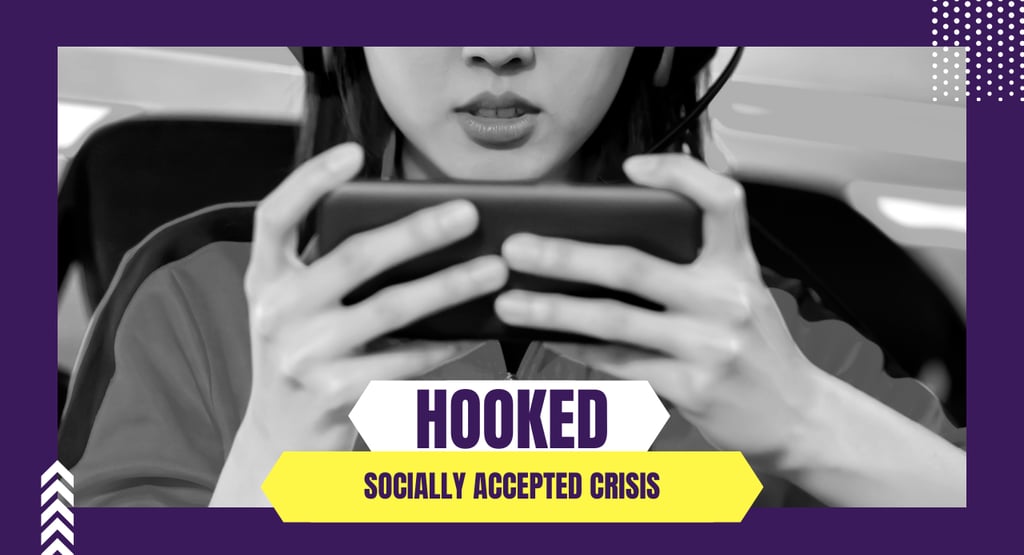

We are living through a crisis so widespread and so normalized that most people don’t even realize they’re caught in it.
It doesn’t look like the addictions we grew up fearing. It doesn’t look dramatic. It doesn’t look dangerous.
It looks ordinary. It looks harmless. It looks like everyday life.
But the truth is simple:
Addiction has become normal — and because everyone is doing it, we’ve stopped seeing the danger.
The New Addiction We Don’t See
When people hear “addiction,” they imagine extremes — casinos, drugs, alcohol, dark rooms, flashing screens.
But today’s addiction looks like:
checking your phone without thinking
scrolling even when you’re not bored
“One more game” that becomes five hours
needing constant stimulation
feeling restless when things get quiet
These aren’t quirks. These aren’t harmless habits. These are early signs of a brain losing control.
And because everyone is doing it, we don’t see the problem.
How the Brain Gets Hijacked
Let’s break down the science in simple terms.
1. Dopamine Conditioning
Every notification, win, like, follow, or reward triggers dopamine — the brain’s “do it again” chemical.
The more dopamine you get, the more dopamine you need.
2. Prefrontal Cortex Fatigue
This is the part of the brain responsible for:
self‑control
decision‑making
long‑term thinking
When overstimulated, it gets tired — and impulses take over.
3. Autopilot Mode
The brain stops choosing. It starts reacting.
Habits → reflexes → compulsions → addiction.
Addiction doesn’t start with a drug. It starts with repetition.
When Everyone Is Addicted, No One Notices
We’ve normalized the very behaviors that erode self‑control.
We call it:
“routine”
“habit”
“just checking”
“just scrolling”
But the brain doesn’t care what we call it.
Every time you repeat it, you’re basically laying down fresh pavement on your brain’s bad habit highway.
Give in to that urge enough times and—congratulations—it’s now a habit.
Every habit becomes autopilot.
And autopilot is the birthplace of addiction.
Addiction Is Not About the Object
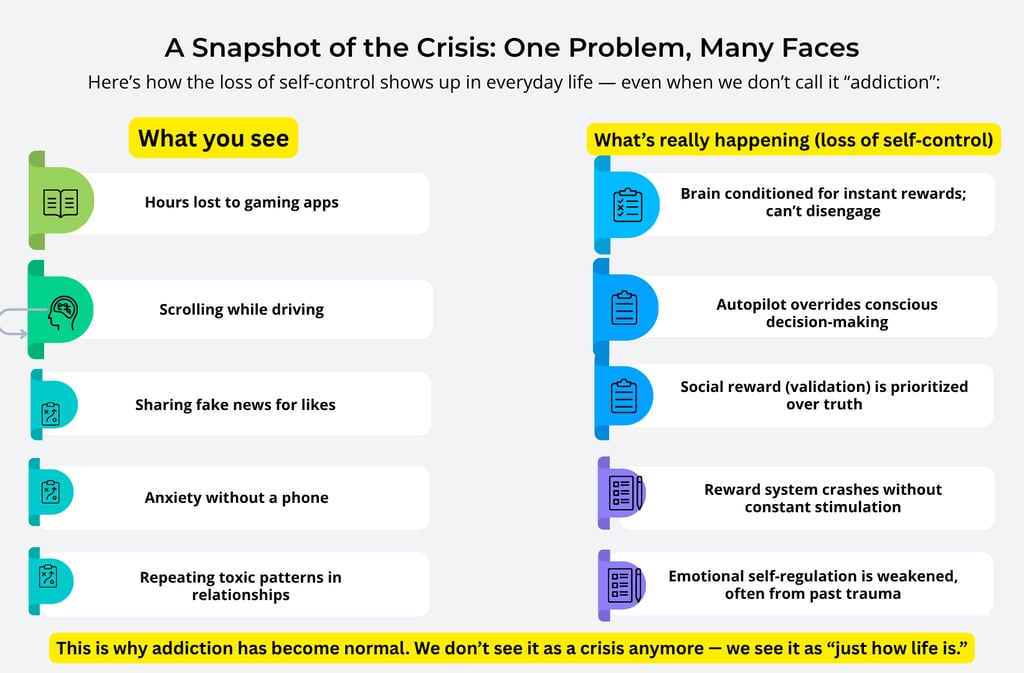
Whether the trigger is a slot machine, a gaming app, alcohol, food, social media likes, or even an unhealthy emotional attachment — the underlying mechanism is the same:
The reward system overrides the brain's brake pedal.
Neuroscience shows that addiction erodes the neural scaffolds that enable self‑control. The brain loses its ability to pause. And once that ability collapses, almost any repetitive reward can trap you.
That’s why we see:
Online gaming addiction is skyrocketing
Social media compulsions are becoming the norm
Emotional trauma (Post Traumatic Stress Disorder) rewires the same circuits
It’s never just the “thing.” It’s the loss of control over the thing.
The Problem Isn’t the Phone. It’s What the Phone Does to Your Brain.
Let’s be honest: you’ve probably used your phone while walking, driving, or even in the bathroom. Not because you needed to — but because the urge felt automatic.
That autopilot mode is the first sign of a weakened self‑regulation system.
And opportunistic marketers, game designers, and social platforms know exactly how to exploit this vulnerability. They weaponize the reward system. It lets your guard down — like weakening a blood‑brain barrier — and uses incentivization to keep you hooked.
Monetization has become the engine of addiction.
Likes, follows, shares → dopamine hits
“Breaking news” races → validation at the cost of truth
Scrolling as a default state → no pause to ask “why am I doing this?”
We have become a society of influencers, in which fame is mistaken for credibility and accuracy is secondary to attention.
Micro-Interventions: Brief Actions Facilitating Neural Rewiring
The Ten-Second Pause Technique
Before interacting with a mobile device, pause for 10 seconds.
Although this strategy appears simple and straightforward, it is highly effective.
This brief pause may:
interrupt the dopamine-driven reward loop
activate the prefrontal cortex
restore conscious decision-making
reduce compulsive behaviors
This process constitutes neurological retraining.
The Efficacy of Simple Brain Games
Brain games may appear elementary; this design is intentional.
These activities are not intended for entertainment or promotional purposes.
They are specifically designed to:
tame impulses
rebuild focus
strengthen working memory
increase frustration tolerance
restore self-control
These represent the precise cognitive skills that addiction impairs.
Brain games should not be regarded as toys.
They function as neurorehabilitation tools presented as simple tasks.
The Rise of Vanity, Misinformation, and the “Influencer Illusion”
Adding to that, this side of the crisis is more dangerous than most people think.
Vanity and attention-seeking behaviors on social media have escalated to levels that distort reality, undermine credibility, and incentivize impulsive actions.
People no longer pause to verify information. They rush to post what they believe is “breaking news” in hopes of being the first to get likes, shares, and follows.
We see it everywhere:
Cutting corners in content creation
Plagiarizing for quick clicks
Justifying unethical behavior as a “survival instinct.”
This isn’t just about ego.
This is addiction in disguise.
The neurological reward associated with being the first to share information is significant.
Every time someone posts something sensational — even if it’s unverified — they receive:
likes
comments
shares
attention
Each reaction functions as a neurological reward, reinforcing the behavior.
Each reward further reinforces the underlying behavior.
Repeated reinforcement progressively strengthens the addictive pattern.
This is how misinformation spreads faster than truth.
We’ve become a society of influencers — not thinkers.
Somewhere along the way, fame became a credential.
A large following became a substitute for:
expertise
credibility
authority
integrity
People now trust:
the loudest voice
the most dramatic post
the most viral content
the most confident storyteller
Not the most accurate one.
This is how disinformation thrives.
This is how false narratives spread.
This is how society becomes misled — not by malice, but by addiction.
The influencer illusion
Anyone with a large following is treated as:
an expert
a leader
a role model
a source of truth
But influence is not the same as wisdom.
Popularity is not the same as credibility.
Virality is not the same as value.
And yet, the addicted brain doesn’t care.
It chases stimulation, not truth.
It seeks validation, not accuracy.
It rewards speed, not reflection.
The real danger
When people are addicted to attention:
truth becomes optional
accuracy becomes secondary
Integrity becomes inconvenient
Impulsivity becomes normal
misinformation becomes entertainment
Dangerous, annoying pranks earn high clicks
Women showing too much skin for likes
This is not just a social problem.
This is a neurological crisis.
A society addicted to attention becomes a society vulnerable to manipulation.
The Link to Addictive Behaviors
This pattern of behavior is closely related to gaming addiction, smartphone addiction, and compulsive scrolling.
It is the same mechanism:
dopamine seeking
impulse acting
validation craving
self‑control weakening
The addiction to attention is simply another branch of the same tree.
Loss of Self-Control from A Clinician’s Perspective: From Direct Experience
I would like to share an insight. At this age, in my late fifties, I’ve spent my young adult days in a third-world country, living in survival mode and scarcity. In addition to my professional career, I have gained decades of experience in the emergency room, cardiac units, radiology, long-term care settings, and the businesses I've worked with.
Addiction is a loss of self-control. It is not a character flaw; rather, it arises when cognitive control is diminished and emotional direction is lost.
I’ve seen it in patients.
I’ve seen it in families.
I’ve seen it in colleagues at work, business partners, my friends, family, and even my employer.
And if I’m being honest, I’ve lost control of myself on days when life gets too loud. Able to take back control is a micro-win.
People think addiction is about “lack of discipline.”
It goes deeper than just discipline.
Addiction is a more complex phenomenon.
It’s what happens when:
The mind can’t regulate impulses.
The heart can’t regulate emotions.
and the body reacts faster than the person can think
It’s the moment someone says, “I knew better… but I still did it,” and they mean it with their whole chest.
Different stories.
Same mechanism. That's not just a lack of discipline. It's a loss of self-control!
Why EQ Is the Missing Medicine
Here’s the part rehab programs often miss: Addiction isn’t just a behavior problem — it’s a regulation problem.
If you can’t regulate your emotions, you can’t regulate your impulses. If you can’t regulate your impulses, you can’t regulate your behavior.
That’s why emotional intelligence — real EQ, not the Instagram version — is essential.
EQ teaches people to:
notice what they feel
understand why they feel it
tolerate discomfort
pause before reacting
choose instead of obeying
Aha moments are powerful medicine.
Neuroplasticity: The Brain’s Redemption Story
One of the most hopeful things I’ve ever learned — and taught — is this:
The brain can change. At any age. At any stage. Even after trauma.
Neuroplasticity is the brain’s way of saying, “Give me a chance. I can do better.”
But here’s the catch: The brain doesn’t rewire through excitement. It rewires through repetition.
That’s why I wanted to contribute to the solution by creating a Brain Game that matters. Not to purposely sell an app, because I'm giving it for FREE.
But with the hope that it will help users regain control of their:
attention
impulse
working memory
frustration tolerance
emotional regulation
These are the exact circuits addiction weakens.
Why Rehab Needs Both: EQ + Brain Training
If I could redesign every behavioral rehab program, I’d make two things mandatory:
Emotional intelligence training
Neuroplasticity‑based brain exercises
Because without EQ, people don’t understand their triggers.
Without brain training, they can’t control their impulses.
And without both, relapse becomes a revolving door.
Addiction recovery isn’t just about stopping the behavior.
It’s about rebuilding the person.
And that rebuilding starts with awareness, compassion, and simple, consistent rewiring.
Conclusion — The Crisis We Didn’t See Coming (And Why We Must Take Our Minds Back)
Because the truth I’ve learned from decades in healthcare and human behavior:
People don’t cheat because they’re bad. They cheat because their nervous system is overwhelmed.
When the brain is in survival mode:
ethics shrink
impulses grow
fear takes the wheel
long‑term thinking disappears
This is why regaining awareness and self‑control isn’t optional anymore — it’s survival.
This is why EQ training isn’t a luxury — it’s a lifeline. This is why Brain Game training isn’t childish — it’s neurological rehab. This is why micro‑interventions matter — they interrupt the loop before the loop becomes your life.
Because at the end of the day, the real crisis isn’t the phone, the app, the algorithm, or the marketer.
The real crisis is losing ourselves without realizing it.
And the real solution is reclaiming:
our attention
our awareness
our emotional clarity
our ability to pause
our power to choose
One small moment at a time.
If addiction has become normal, then healing must become normal too.
And it starts with the simplest, most courageous act:
Taking your mind back.
Where to Begin Your Healing Journey
If this article resonated with you — if you saw yourself, your child, your partner, or someone you love — then you don’t have to walk this path alone. I’ve created tools that are simple, accessible, and designed for real‑world healing.
ADHD Book + FREE Online Brain Game Exercises
This book includes free lifetime access to the online Brain Game exercises — no apps to download, no sign‑up fees, no free trials, no renewals, no hidden subscriptions.
Just tools that work. Tools that retrain the brain. Tools that help you take your mind back.
Get it here: https://payhip.com/b/N6Udt
EQ: Emotional Intelligence in the Age of Overwhelm (Paperback)
If you want to strengthen your emotional regulation, rebuild self‑control, and understand the emotional roots of compulsion, this book is your foundation.
Available on Amazon: https://www.amazon.com/dp/B0GW3L5VR9
These resources are not “products.” They are interventions — built from decades of clinical experience, neuroscience, and lived human stories.
If addiction has become normal, then healing must become accessible.
And it starts with awareness, compassion, and the willingness to take one small step toward reclaiming your mind.


Joel Inocencio, BSN, RN, is a veteran nurse, author, and educator who has spent decades at the bedside witnessing how stress, trauma, and modern life shape the human mind. His mission is to make emotional intelligence and brain‑training accessible to everyday people. Through his books and online resources, he helps readers reclaim awareness, rebuild self‑control, and navigate life with clarity and compassion.
The Social Media Manipulation Layer
Here’s another part most people don’t realize:
And when opportunistic marketers exploited the weakness in our reward system, they monetized it.
Suddenly, everything became a competition:
who posts first
who gets the most likes
who goes viral
who gets monetized
Accuracy became optional. Integrity became negotiable. Originality became “optional.”
And the justification?
The Hidden Driver: Scarcity Mentality
The other layer most people miss: the urge to monetize, to earn, to survive — even at the cost of honesty.
That scarcity mentality is sabotaging our society’s progress, pulling us back toward primitive, reactive thinking. And it directly weakens self‑control — because when you feel you have no margin, you stop pausing. You grab what you can, right now.
That’s not ambition. That’s impulse without a brake.
Reclaiming the Brain: The Path Toward Restoring Self-Control
Addiction impairs the following cognitive and emotional functions:
attention
impulse control
emotional regulation
critical thinking
But Here’s the Good News: Self‑Control Can Be Trained
You can’t think your way out of a brain that has lost the ability to pause. But you can retrain it.
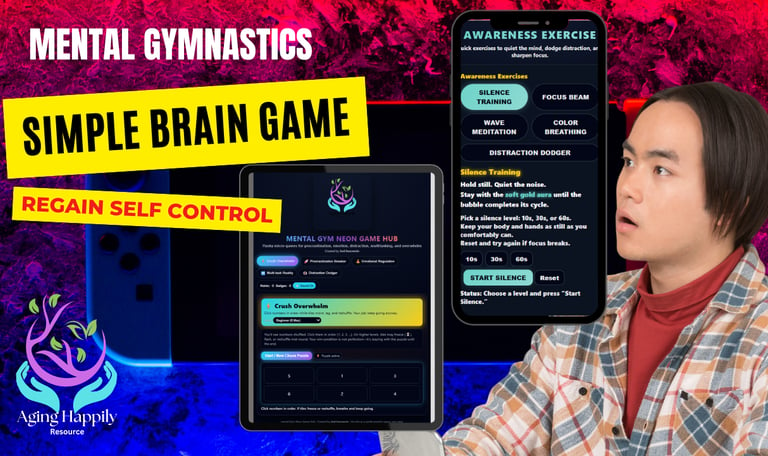
That’s exactly why I created the Mental Gym — a free set of brain games and awareness exercises.
At first glance, these exercises may seem too simple. They aren’t built for hype, thrills, or excitement. That’s intentional.
They are “micro‑interventions”: small, repetitive mental gymnastics designed to:
Strengthen the exact neural circuits that addiction and trauma weaken
Rebuild your ability to pause before acting
Restore emotional self‑awareness (EQ)
Regain control over compulsions, one tiny moment at a time
Think of it as physical therapy for your brain’s brake pedal.
Why “Simple” Works Where “Extreme” Fails
Loud, flashy, high‑intensity programs might feel productive — but they often bypass the deep wiring that matters most.
Addiction and compulsive behavior thrive on autopilot.
The Mental Gym works by interrupting autopilot in small, repeatable ways.
These exercises train your brain to:
Notice an urge
Pause for just one breath
Choose a different response
That pause — measured in seconds — is where freedom begins.
And because this training is free and accessible, there’s no barrier to starting. No monetization trap. No hidden hook. Just honest brain‑building.
Contact
Questions or thoughts?
admin@aginghappilyresource.com
© 2025.
Aging Happily Resource.
All rights reserved.