
Admitted or Just ‘Under Observation’? The Medicare Trap That Could Cost You Thousands
Think a hospital bed means you're admitted? Not always. Medicare's "observation status" can leave you with massive bills and no skilled nursing coverage, if needed—even after a multi-day stay. Learn the one question you must ask, how the decision is really made, and how to appeal before it's too late.
Joel Inocencio
7/19/20266 min read


What You Should Do
Ask in writing (or have a family member ask) about your status as soon as possible.
If you receive a MOON or MCSN, read it immediately and note appeal deadlines.
For help with appeals or understanding notices: Contact your free State Health Insurance Assistance Program (SHIP) at shiphelp.org or call 1-800-MEDICARE.
Check your Medicare Summary Notices (MSNs) in your MyMedicare.gov account.
For the most official and up-to-date details, visit:
CMS MOON page
CMS Hospital Appeals – Change of Inpatient Status page (Alexander v. Azar)
Medicare.gov appeals section
You're in a hospital gown. You've spent the night in a bed. Nurses check your vitals, doctors make their rounds, and meals arrive on a tray. By every possible measure, you feel like you've been admitted to the hospital.
But Medicare might see it differently.
There's a quiet distinction that happens behind the scenes—often without you ever knowing it—that can turn what you thought was a covered hospital stay into a massive out-of-pocket bill. It's called observation status, and it's one of the most expensive misunderstandings in the Medicare system.
Here's the shocker: you can spend three full days in a hospital bed and still technically be an "outpatient." And when that happens, Medicare Part A doesn't pay a dime. Instead, you're billed under Part B, with copays for every service, no cost cap, and—worst of all—those days don't count toward the 3-day inpatient requirement needed for Medicare to cover a skilled nursing facility after discharge.
The result? Thousands of dollars in unexpected bills, and potentially no coverage for the rehab or nursing care you desperately need.
But here's the good news: you have rights, and you have options. You can ask the right questions, request a review, and even appeal the decision—if you act in time.
In this article, we'll break down exactly what observation status means, how hospitals decide whether to admit you or keep you under observation, and—most importantly—what you can do to protect yourself and your savings.
The Inpatient vs. Observation Status Dilemma: What Every Medicare Beneficiary Needs to Know
If you or a loved one are admitted to the hospital on Medicare, the first question you need to ask is: "Am I being admitted as an inpatient, or am I under observation status?"
It sounds like a technicality—you're in a hospital bed either way—but the distinction can have serious financial consequences. This article explains what the difference means, how your hospital stay status is determined, and what you can do if you disagree with the decision.
The Core Difference: Inpatient vs. Observation
Let's start with the basics:
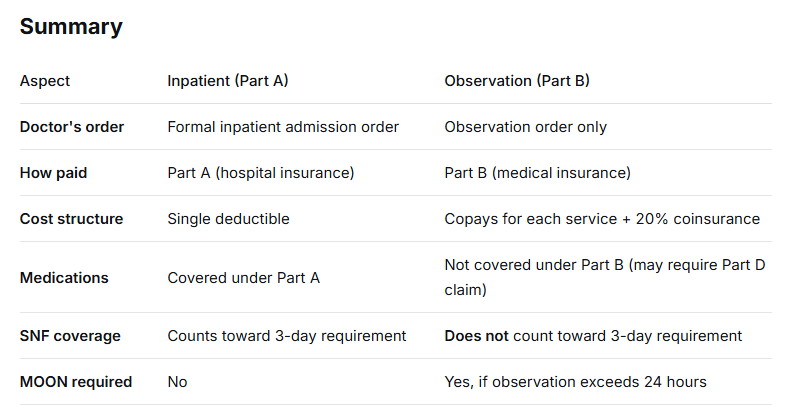
Inpatient status begins when a doctor writes a formal order admitting you to the hospital. Your care is covered under Medicare Part A (hospital insurance).
Observation status means you're receiving outpatient services while the hospital monitors your condition to determine whether you need to be formally admitted. Your care is covered under Medicare Part B (medical insurance).
Here's the catch: you can spend multiple nights in a hospital bed and still technically be an outpatient under observation status—and that's where the financial trouble begins.
Why the Difference Matters
The financial impact of being under observation status versus inpatient admission can be substantial:
Cost Differences
Inpatient (Part A): You pay a single deductible for your entire hospital stay—$1,736 in 2026.
Observation (Part B): You pay a copayment for each individual service, plus 20% coinsurance on many services. While each individual copay cannot exceed the Part A deductible, your total out-of-pocket costs can actually be higher than if you were admitted as an inpatient.
Prescription Drug Coverage
Inpatient: Medications are generally covered under Part A during your stay.
Observation: Routine medications are not covered under Part B. If you have a Part D prescription drug plan, you may need to pay out-of-pocket and submit a claim for reimbursement—and if the hospital pharmacy is out of your plan's network, you could pay even more.
The Skilled Nursing Facility Rule
Perhaps the most significant consequence: time spent under observation does not count toward the 3-day inpatient stay required for Medicare to cover a stay in a skilled nursing facility (SNF) after discharge.
This means you could be in the hospital for several days—all under observation status—and then be told you need rehab or skilled nursing care, only to discover Medicare won't cover it because you weren't an inpatient for the required three days. The result: you could be facing the full cost of SNF care out of pocket.
How Are These Decisions Made?
You raised an excellent point in your response: hospital staff—specifically Utilization Review (UR) nurses—use standardized criteria to help determine the appropriate status for each patient. This is exactly right.
InterQual and MCG (Milliman Care Guidelines) are the industry-standard software tools used by hospitals to assist physicians in making disposition decisions between observation and inpatient admission. These are not simple checklists; they contain numerous, broad criteria that assess the severity of illness and the intensity of services required.
Here's how the process works in practice:
The Medicare Two-Midnight Rule serves as the foundational guideline. Generally, if a patient is expected to need medically necessary hospital care that crosses two midnights, inpatient admission is typically appropriate. If care is expected to last less than two midnights, observation is usually appropriate.
The physician writes the admission order, which must clearly indicate whether the patient is being admitted for inpatient or observation status.
The Utilization Review team uses tools such as InterQual and MCG to validate that the documentation supports the selected status. If the criteria for inpatient admission are not met, Medicare may deny reimbursement for the inpatient claim. In these cases, the hospital may place the patient under observation status instead.
The UR team isn't directing the doctor; they serve as an extension of the physician advisor, providing guidance and education so clinicians can make the most appropriate status determination for Medicare patients.
The bottom line: The decision ultimately rests with the physician's medical judgment, but it must be supported by documented criteria and clinical necessity. If the doctor's findings fail to meet the criteria for either inpatient or observation status, a claim for reimbursement of the service may be denied.
What Hospitals Are Required to Tell You
Hospitals have obligations to notify you about your status:
The Medicare Outpatient Observation Notice (MOON): If you receive observation services for more than 24 hours, the hospital must provide you with this notice. The MOON informs you that you are an outpatient, explains that you'll be billed under Part B, and notes that Medicare may not cover a subsequent stay in a skilled nursing facility. The hospital must provide this notice within 36 hours of the beginning of observation services.
Updated forms: CMS has released updated MOON forms (form CMS-10611) with improved readability. Hospitals must begin using the new form by April 21, 2026.
Your Rights and What You Can Do
You have the right to ask about your status at any time. Hospital staff can tell you whether you're under observation or admitted as an inpatient.
If You Disagree With Your Status
There are now formal appeal processes available—a relatively new development stemming from a class action lawsuit (Alexander v. Azar) implemented in 2025.
Expedited Appeal (Before Discharge)
If the hospital changes your status from inpatient to observation while you're still in the hospital, and either:
You don't have Part B coverage, or
You have stayed in the hospital for 3 or more consecutive days but were classified as an inpatient for fewer than 3 days
You can file an expedited appeal with a Quality Improvement Organization (QIO).
You must receive a Medicare Change of Status Notice (MCSN) from the hospital before discharge.
You can appeal before discharge—do this, because if you wait until after you're discharged, the hospital may bill you while the appeal is pending.
The QIO must issue a decision within 1 day for expedited requests.
If successful, Medicare Part A will cover your inpatient hospital stay, and you may qualify for Medicare-covered SNF services.
Retrospective Appeal (For Past Stays)
If you had a hospital stay on or after January 1, 2009, where the hospital changed your status from inpatient to observation, you may be eligible for a retrospective appeal.
Deadline: You must file by January 2, 2026.
This applies if you didn't have Part B at the time, or if your stay was at least 3 days but you were an inpatient for fewer than 3 days.
The appeal follows a five-level process similar to other Medicare appeals.
Recent Legislative Developments
A bill currently before Congress—the Improving Access to Medicare Coverage Act of 2026—would amend the Social Security Act to count periods of outpatient observation services toward the 3-day inpatient requirement for SNF coverage. If passed, this would be a significant expansion of coverage for beneficiaries who spend time under observation. The bill would apply to observation services beginning on or after January 1, 2026
Final Thoughts
The inpatient vs. observation status distinction is one of the most confusing—and costly—areas of Medicare. You have every right to understand your status, ask questions, and appeal if you disagree. The good news: new appeal rights have expanded your ability to challenge these decisions, both before and after discharge.
The use of criteria like InterQual and MCG is standard practice and helps ensure consistency in these decisions. These criteria are complex and not easily summarized in a simple Q&A.
The most practical advice remains: ask about your status as soon as you're admitted. If you're told you're under observation and you believe inpatient care is medically necessary, you have the right to ask for a review. And don't wait to appeal—your best chance at avoiding high out-of-pocket costs is to act before you leave the hospital.
Contact
Questions or thoughts?
admin@aginghappilyresource.com
© 2025.
Aging Happily Resource.
All rights reserved.