
The Caregiver's Guide to Advocacy: How Your Voice Can Turn Bills into Law
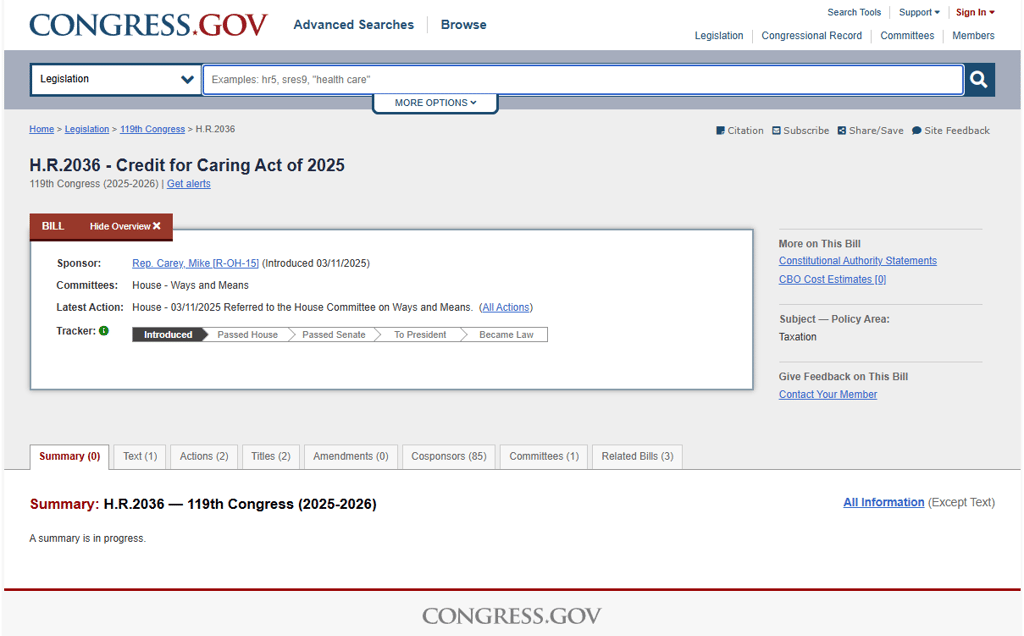
Credit for Caring Act (H.R. 2036 / S. 925): up to $5,000 in tax credit for working family caregivers. Introduced in March 2025 with 81+ bipartisan cosponsors. Currently hanging because no cost estimate has ever been produced, and tax committees won't move without one.
7/15/20263 min read
If you're one of the millions of Americans caring for an aging parent, spouse, or loved one, you know the financial weight of that responsibility all too well. Family Caregivers spend an average of $7,200 out of pocket each year on caregiving costs—roughly 26% of their income.
For many, this means dipping into savings, taking on debt, or even leaving the workforce entirely.
Right now, three bipartisan bills sitting in Congress could change that. They don't have floor votes scheduled—but that can change if family caregivers raise their voices.
Here is what you need to know and exactly how you can help move these bills forward.
The Three Bills That Could Help You
1. Credit for Caring Act (H.R. 2036 / S. 925)
This bill would create a tax credit of up to $5,000 for working family caregivers who pay qualified caregiving expenses. To qualify, caregivers must have earned income over $7,500 and provide care for a certified individual with long-term care needs.
The credit covers expenses such as home modifications, assistive technologies, transportation, respite care, and even lost wages from unpaid time off. It was introduced in March 2025 and has over 81 bipartisan cosponsors.
2. Lowering Costs for Caregivers Act (H.R. 138 / S. 1565)
Currently, caregivers can use tax-free HSA or FSA funds for a parent's medical expenses only if the parent is classified as a dependent. This bill would change that—allowing caregivers to use these pre-tax accounts for a parent's or parent-in-law's qualified medical expenses, regardless of dependency status. A coalition of 95 organizations, including AARP, the Alzheimer's Association, and the National Council on Aging, has sent a letter urging Congress to pass this bill.
3. Catching Up Family Caregivers Act (S. 4291)
Family caregivers who step away from work often fall behind on retirement savings. This bill would allow caregivers who have completed at least 500 hours of caregiving in a year (and worked fewer than 500 paid hours) to make the same "catch-up" retirement contributions available to people over 50—for up to five years after they return to work . It was reintroduced in April 2026 with bipartisan support from Senators Collins and Warner.
While We Wait for Congress
The legislative process takes time. If you need help navigating caregiving options now, services like tendercare can connect you with vetted senior care professionals and help identify what support you qualify for.
Your Voice Matters
Family caregivers are the backbone of America's long-term care system. You save taxpayers billions by keeping loved ones out of costly institutional settings. Lawmakers need to hear from you directly about the financial and emotional toll of caregiving.
These three bills won't solve everything—but they would provide meaningful relief to millions of families. The 95-organization coalition behind the Lowering Costs for Caregivers Act shows that support spans party lines and advocacy sectors. Now it just needs public pressure.
Take five minutes today. Call, post, share—and let your representatives know that family caregivers are watching and waiting.
Additional help here: GUIDE: Medicare Funding for Family Caregivers taking care of loved ones with Dementia
Why These Bills Are Stalled
Each bill faces its own procedural hurdle:
The Credit for Caring Act requires a cost estimate from the Congressional Budget Office before tax committees will advance it.
Lowering Costs for Caregivers Act has no "vehicle"—it needs to be attached to another bill already moving through Congress.
The Catching Up Family Caregivers Act was introduced late in the congressional calendar and is pending before the Senate Finance Committee.
The common thread? They need more cosponsors and more public pressure to get a floor vote.
How You Can Make a Difference
1. Join the Advocacy Community
The Facebook group Aging Happily Resource is a space for family caregivers to share experiences, learn about policy changes, and coordinate advocacy efforts. Join to stay informed and connected with others who understand what you're going through.
2. Contact Your Representatives
You don't need to be a policy expert. Just mention the names of these bills and ask your representative to cosponsor them.
Find your representative: Visit House.gov and enter your ZIP code
Call or email: Share a brief message like: "I'm a family caregiver. Please cosponsor the Credit for Caring Act (H.R. 2036), the Lowering Costs for Caregivers Act (H.R. 138), and the Catching Up Family Caregivers Act (S. 4291). Family caregivers need this support now."
3. Leverage Social Media
Post on Facebook, X (Twitter), and Instagram using the bill names and hashtags like #FamilyCaregiversAct and #CaregiverTaxCredit
Share your personal story—nothing moves a lawmaker more than a constituent's lived experience
Tag your representatives in posts to get their attention
Repost content from advocacy organizations like AARP and the National Alliance for Caregiving
4. Use Advocacy Toolkits
Organizations like the National Alliance for Caregiving offer ready-to-use toolkits with sample social media posts, email templates, and graphics you can share. These make advocacy simple and effective.
5. Consider Joining AARP
AARP has been leading the charge on these bills. Their advocates took more than 6.9 million actions to protect Social Security in 2025 alone. By becoming a member or volunteer, you join a powerful, nonpartisan advocacy network that lawmakers take notice of. You can sign up to become an activist at AARP's advocacy page
Contact
Questions or thoughts?
admin@aginghappilyresource.com
© 2025.
Aging Happily Resource.
All rights reserved.